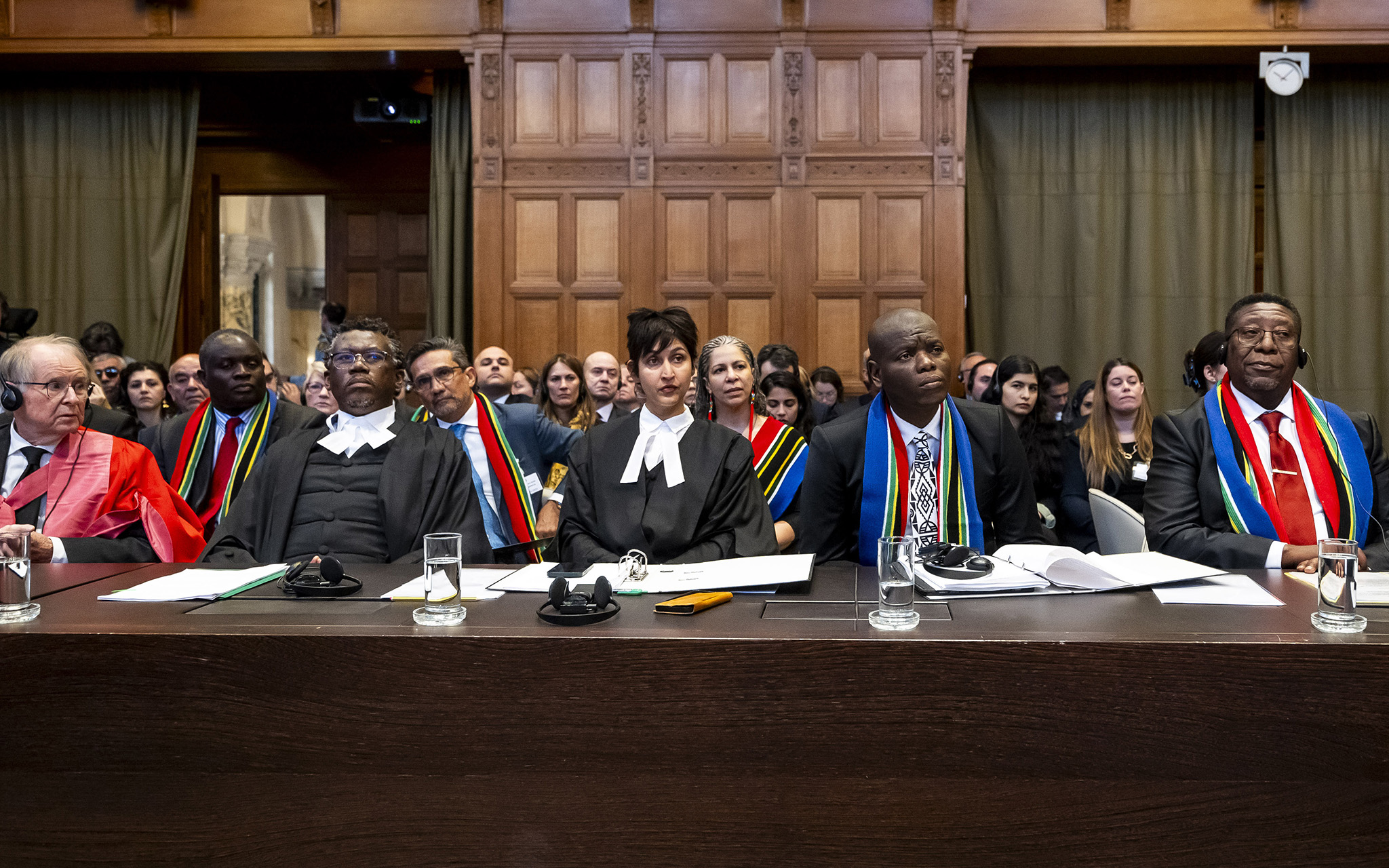
South Africa vs Isreal: The ICJ
South Africa called upon the ICJ has been asked to decide whether Israel is violating the Convention on the Prevention and Punishment of the Crime of Genocide in the Gaza Strip (South Africa v. Israel)
The case before the court, South Africa v. Israel, crystallised two competing narratives: one that the Palestinian people, forcibly displaced and denied their right of self-determination since the founding of the State of Israel in 1948, and subjected to oppression and occupation ever since; and the opposing version that the Jewish people, who were finally able to establish an independent state in their historical homeland after generations of persecution and pogroms in exile, culminating in the systematic murder of six out of 17 million Jews during the Holocaust, and who have been under threat from hostile neighbours ever since. The problem with adversarial proceedings is that these narratives may be framed as mutually exclusive, when in fact both are true – writes Chimène Keitner, a Martin Lurther King Jr Professor of Law at the University of California Davis School of Law.
On December 29, 2023, South Africa filed its request to the ICJ to have provisional measures put in place in Gaza that would put an end to what South Africa deemed to be genocidal acts committed by Israel on the Palestinian population. Whilst condemning the actions of Hamas, South Africa called upon the ICJ to determine if Israel had plausibly violated the prohibition of genocide. The Court was expected to announce a decision weeks after the hearing, with South Africa having a keen interest on the possible grant of a preliminary order that would give the Palestinian civil population much needed relief.
What is the ICJ?
The ICJ, short for Intentional Court of Justice, is the only international Court that adjudicates general disputes between nations, and gives advisory opinions on international legal issues. It is one of the six organs of the United Nations and was established by the United Nations (UN) Charter in June 1945 and serves as the UN’s top court. Article 92 of the UN Charter provides that the ICJ “shall be the principal judicial organ of the United Nations” and shall function in accordance with the Statute of the International Court of Justice. The court is based in The Hague (Netherlands) and is composed of 15 judges elected for nine-year terms by the UN General Assembly and the UN Security Council.
Only states may be parties in cases before the court. In terms of its mandate, Article 36(1) states that the jurisdiction of the court comprises “all cases which the parties refer to it and all matters specially provided for in the Charter of the United Nations or in treaties and conventions in force.” Article 41(1) of the statute empowers the court, in any case before it, “to indicate, if it considers that circumstances so require, any provisional measures which ought to be taken to preserve the respective rights of either party.”
What Triggered South Africa’s Legal Action?
Taking care not to ignore the historical geopolitical background of the conflict, the economic motives following the discovery of a trillion cubic feet of gas on the Gaza shoreline in the 1990s, and the US-Israeli plan to reduce dependence on the Suez Canal for global trade reasons, the case was about the nature, scope and extent of Israel’s military operations in Gaza since the heinous October 7, 2023 attack by the terrorist group Hamas. At the time the case was filed, aroud 28,000 people had died in Gaza and millions had been displaced since Israel launched its counter-offensive. The fundamental question before the ICJ was whether Israel’s actions in Gaza amount to violations of its obligations under the Genocide Convention.
What Exactly Did the Court Decide?
On Friday, January 26, 2024, a panel of 17 judges of the ICJ delivered its ruling on Africa’s request for the indication of provisional measures submitted in the landmark case. Firstly, the court concluded that it had jurisdiction to hear the case pursuant to Article IX of the Genocide Convention contrary to Israel’s argument. Secondly, the court concluded, prima facie, that South Africa had standing to submit the dispute with Israel concerning alleged violations of obligations under the Genocide Convention to it. Thirdly, and most significantly, the court ordered several provisional measures.
What are the provisional measure ordered by the Court?
In summary the court ordered Israel:
- To take all measures within its power to prevent the commission of all acts within the scope of Article II of the Genocide Convention, in particular:
- (a) killing members of the group;
- (b) causing serious bodily or mental harm to members of the group;
- (c) deliberately inflicting on the group conditions of life calculated to bring about its physical destruction in whole or in part; and
- (d) imposing measures intended to prevent births within the group;
- To ensure with immediate effect that its military does not commit any acts within the scope of Article II of the Genocide Convention;
- To take all measures within its power to prevent and punish the direct and public incitement to commit genocide in relation to members of the Palestinian group in the Gaza Strip;
- To take immediate and effective measures to enable the provision of urgently needed basic services and humanitarian assistance to address the adverse conditions of life faced by Palestinians in the Gaza Strip; and
- To take effective measures to prevent the destruction and ensure the preservation of evidence related to allegations of acts within the scope of Article II and Article III of the Convention on the Prevention and Punishment of the Crime of Genocide against members of the Palestinian group in the Gaza Strip.
What is the significance of the Court’s Order?
The court’s order is very significant in that although it did not order a ceasefire, if fully implemented, the decision could mean the end or scaling down of Israel’s military operations in. By virtue of Article 60 of the Statute, judgments of the ICJ are final, without appeal, and binding. This means that Israel cannot overturn the court’s January 26 order and not even the UN Security Council has the power to overturn or veto a decision of the ICJ. Although highly significant, this is only an interim decision. This court is yet to rule on the fundamental question whether nor not Israel violated the Genocide Convention.
How Will the Court’s Order be Monitored?
The ICJ does not have monitoring or enforcement capabilities. However, the court ordered Israel to submit a report to the court “on all measures taken to give effect to its Order within one month as from the date of the Order.” Recent reports seemingly indicate that Israel has failed to comply with at least one measure of the ICJ’s legally binding order and the world is anxiously watching for the next action to be taken by world leaders to save human lives from irreparable harm.
Image Source: https://timesofmalta.com/article/south-africa-accuses-israel-breaching-genocide-convention.1077432
alqalam.co.za/south-africas-icj-application-is-a-challenge-to-wests-rules-based-order/